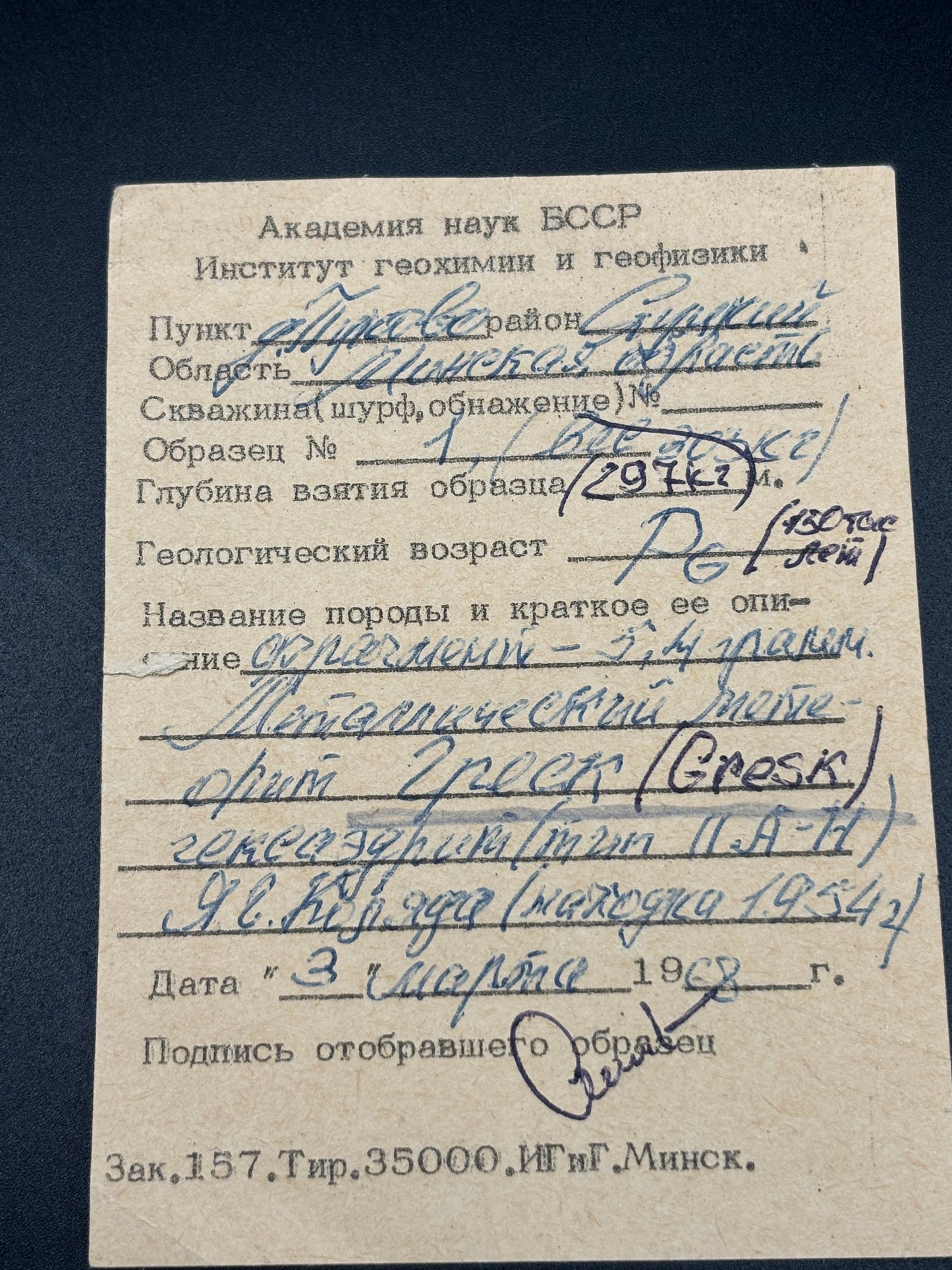
An authentic 4.4 gram specimen of the officially classified Gressk meteorite, a rare IIAB iron meteorite discovered in Belarus in 1955. Originally classified as a hexahedrite iron in Meteoritical Bulletin 6 and later refined to the IIAB iron meteorite group, Gressk represents a remarkable survivor from the metallic core of a destroyed ancient asteroid.
Recovered near the village of Pukovo in the Gressk district of the former Byelorussian SSR, the meteorite was discovered in 1955 with a reported total mass of approximately 303 kilograms. Meteorites from Belarus are exceptionally uncommon on the collector market, making authenticated Gressk material increasingly difficult to obtain.
As an IIAB iron meteorite, Gressk formed deep within the molten metallic interior of its parent asteroid during the earliest formation stages of the solar system. These meteorites are composed primarily of iron-nickel metal and are highly prized for their density, metallic structure, and connection to the exposed planetary cores of ancient protoplanets shattered by catastrophic collisions in space.
Official Classification
-
Name: Gressk
-
Country: Belarus
-
Year Found: 1955
-
Classification: Iron Meteorite (IIAB), previously (1957): Iron-hexahedrite
-
Original Classification: Hexahedrite
-
Total Known Weight: 303 kg
-
Official Publication: Meteoritical Bulletin 6
This 4.4 gram specimen represents an outstanding collectible for:
- Iron meteorite collections
- Planetary science enthusiasts
- Rare locality collectors
- Historic meteorite collections
- Educational and museum displays
- Space and asteroid memorabilia collections
Iron meteorites like Gressk are among the oldest natural objects a collector can hold, originating from the metallic core of an asteroid.
Condition
Please review all photos carefully for overall condition, natural surface texture, oxidation, cut surfaces, and preparation characteristics, as they are considered part of the description. Iron meteorites commonly display natural oxidation and surface variation due to terrestrial exposure and preservation conditions.
Measures: 15 x .5 x .7 mm